Welcome to ‘Drawing On’, an AHRC-funded project (AH/X004325/1) that explores the ways in which comics can be used to teach difficult topics.
We’ve put together this series of little interviews so you can find out more about our team and the project.
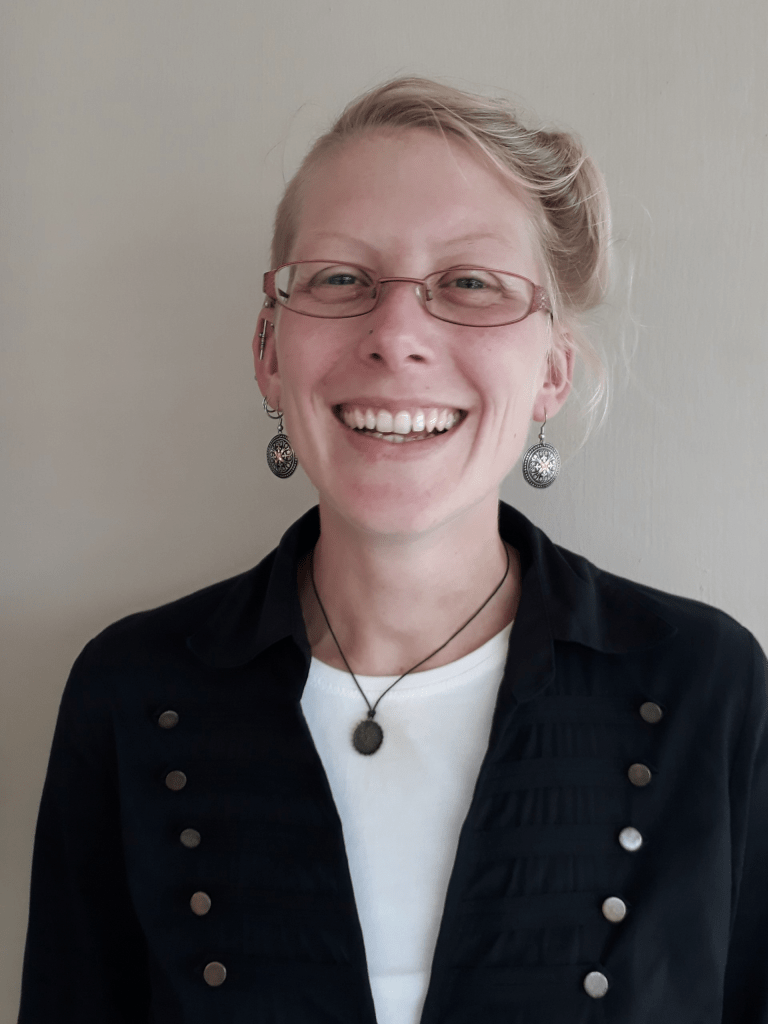
Who are you?
My name is Hannah. I moved from Germany to the UK to go to university here and, apart from a little stint in Mauritius, have lived here ever since. I studied European Studies, Conflict Students, and Law. And now I work as a Lecturer in Law at Liverpool John Moores University. At work, my area of interest is gender-based violence, mainly conflict-related rape and forced marriage. As you can imagine, that can be quite heavy and I need to balance that with something warm and fuzzy when I am not at work, a cuddle with my dogs for example. I also enjoy doing something creative like dancing and crafts. Even though I read a lot for work, I still enjoy a good book (comic or otherwise) in my free time as well, especially with a cuppa and a slice of home-made cake. Cake also goes will with a boardgame. And when I do not get enough fresh air on my dog walks, I go and do some gardening. Music is my constant companion.
When did you first become interested in forced marriage and comics, and how did you get involved with the ‘Drawing On Forced Marriage’ project?
At university, I took a module called ‘Anarchy and Order’, mainly because it had the word anarchy in the title. In one of the lectures, Helen Brocklehurst mentioned a BBC Word documentary about the children born of war in the Former Yugoslavia. This was the spark that ignited my interest in conflict-related gender-based violence. It makes me angry. I want to do something about it. As an academic, I research, write and talk about it. First, ‘it’ was war rape. Now ‘it’ is forced marriage. I try to understand it better, to educate myself and others, because education is the magic key, right?
As part of my legal research training, I studied the relationship between law and the arts. Richard Ireland’s session that dissected the meaning of paintings, Chris Harding’s session in which we discussed the operatic version of Kafka’s In the Penal Colony, and Catrin Fflur Huws’s session on her play about Alan Turing were some of the best classes I have ever been part of. However, it was serious comics that really got my attention. I started reading graphic novels related to my research. Jean-Philippe Stassen’s Deogratias: A Tale of Rwanda and Joe Sacco’s Safe Area Goražde were, and still are, two of my favourites. I read about the educational potential of comics. I drew my own (very basic) comic about conflict-related forced marriage. I am over the moon that now, 10 years later and on the back of my work on Helen McCabe’s AHRC-funded project on the relationship between forced marriage and modern slavery (AH/S012788/1), I won the money to make a proper comic to educate young teenagers about forced marriage and to support their development as allies of those at risk or already experiencing it.
What about the project excites you?
What doesn’t, apart from university bureaucracy maybe?! It is exciting that it is finally happening. It is exciting to see the comic develop from a script, over thumbnails, to the inked and coloured version. It is exciting to learn from my project partners who are experts in anti-forced marriage work, relationship and secondary education, and comics. It is exciting to share ideas and think about all the possibilities of the project with the most congenial research assistant I could have hoped for. But possibly the most exciting, and the most nerve-wracking, part of the project are the school workshops when we get to share the comics, see how students engage with them, and when we have the most amazing discussions.
What was the last comic you read, and did you enjoy it?
The last comic I read was given to me as a gift that carries treasured memories that I carry close to my heart. It is manga version of Shakespeare’s Twelfth Night and I loved it. I did not know the story before and found the comic to be a very accessible introduction, especially because, admittedly, I struggle to understand The Bard. Even though I am not usually a manga fan, I thought the style worked brilliantly to illustrate the drama of the story.
 Drawing on Forced Marriage
Leave a comment