After reviewing Team Muhafiz and the Child Raiders and Cash Cow, I would like to add Daria: A Roma Woman’s Journey to our list of forced marriage comics.
Together, they are painting a more and more complex picture of forced marriage.
They show that forced marriages are a global problem. Statistically speaking, forced marriages are more prevalent in Asia and the Pacific but they also take place in Africa, Europe, and Central Asia. Team Muhafiz is set in Pakistan. Cash Cows tells the story of a Tanzanian girl. Daria does not specify a geographical location but I get the impression that it is set in Europe, specifically, in a Roma community.
Right from the start, the comic presents forced marriage as one of many challenges (to say the least) faced by Daria and her family. Daria’s parents live in a Roma settlement without electricity and only a single water tap. Daria gets dirty looks from members of the public who identify her as “another Roma”. Potential employers mistrust her. Her husband Darco is suspected of theft. Her daughter Jelena is bullied at school and not believed when she tells a teacher. Daria’s father lost his job when Daria was still a child. The same happens to Darco when his kids are still young. Daria’s brothers emigrate to Hungary in search for work, never to return.
Can you guess why Daria was married off by her father? For money. For six months rent.
And can you guess why Daria grabs her children and leaves Darco in the middle of the night while he is out?

Sadly, history has a habit of repeating itself.
But is that easy? Can we really shrug it off as just the same old story? History is not alive, at least not in the sense that it has a mind of its own. People make history, people in power and common people on buses, in schools and workplaces. If people in power would develop effective and fair social security systems, and if common people would be more open minded, maybe families would not have to resort to marrying off their daughters to keep a roof over their heads and food on their tables.
The bleak reality of child marriage driven by economic hardship is reflected in the simple greyscale images of the comic. In addition to setting the tone, the use of light and darkness provides information about the characters. It indicates who the innocent, the good guys, and the baddies are.
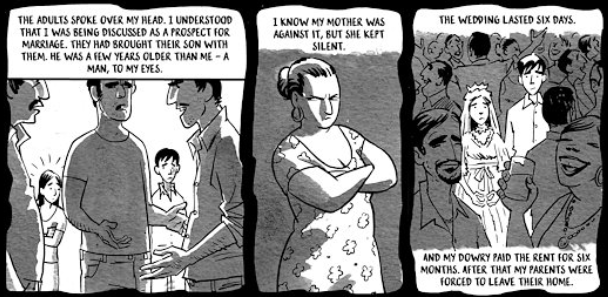
I am particularly struck by the use of shading in the image of Daria’s and Darco’s wedding. It is their day. They are in the spotlight. Everyone else fades away. And yet, they did not chose this. Their marriage was an arrangement between their families in which they did not have a say. The contrast between the “happy” couple and their guests becomes even starker when we look at their facial expressions. While the guests are having the time of their life, Daria and Darco look uncertain, out of place, left out.
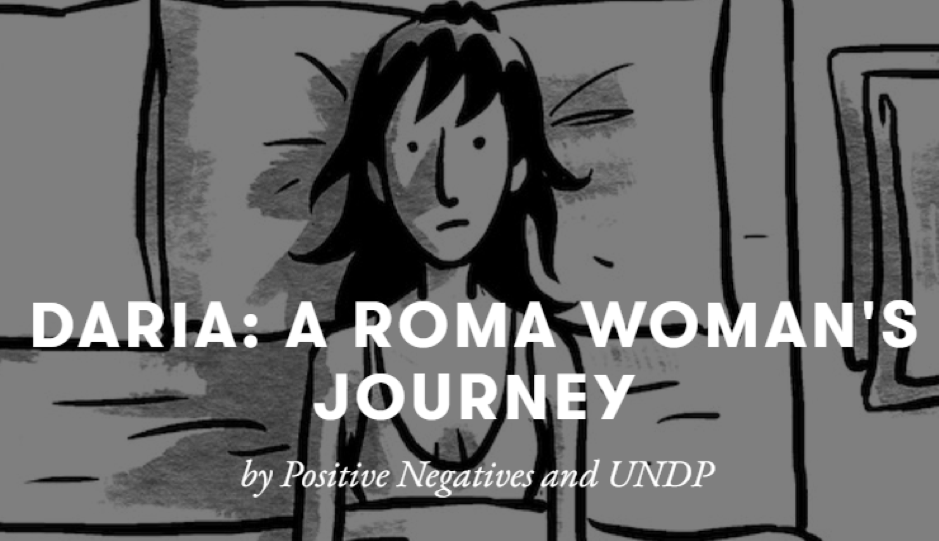
And actually, that expression reappears on Daria’s face when she begins to worry that Darco will sell Jelena for her dowry the way she had been. That is the cover image. It shows Daria lying in bed alone. What presumably is Darco’s side of the bed is empty.
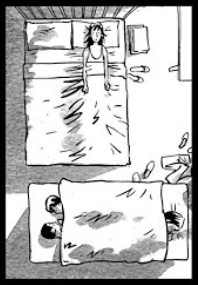
A bird’s eye perspective of the same image reappears as one of the panels in the comic. Here we see that Daria is not alone. Her three children are sharing a bed in the same room. At her wedding, she only had herself to think about (as if that is not enough when you are a child forced into a marriage). Now she also has to think about Jelena and her two sons. While Daria’s expression mirrors the uncertainty of her wedding day, her straight posture and clenched fists show determination. Even before she leaves Darco and their home, she knows that she will not stay silent like her mother did. She knows she is not alone. She knows there is a place where she and her children will be safe. Despite her family’s history, that place is her parents’. We can only imagine what has passed between Daria and her parents since she got married. Whatever it might be, their present relationship is loving, caring, and joyful, just like it used to be before Daria’s father lost his job and their whole misery started. And just like in Team Muhafiz and Cash Cow, when Daria arrives at her parents’ and explains the situation, her father recognises that forced marriage is wrong. While that recognition comes too late for Daria, it shows that history does not have to repeat itself. We can change the story of our lives.
Written by Hannah Baumeister
 Drawing on Forced Marriage
Leave a comment