
A strange shift is occurring within the myth of Persephone and Hades: the young people have gotten hold of it, and they’re making it wholesome. This metamorphosis occurred to me recently as I was scrolling through my Instagram, and a page I follow (@lit.memery – I am who I am) posted the following:

And I’ve seen this occurring a lot on social media platforms, where young adults have taken the myth and decided that Persephone and Hades are ‘relationship goals’. I added a comment to the above @lit.memery post wondering if this move to ‘wholesome-ify’ the myth is inspired by YA plotlines. I can’t help but think of the supernatural boyfriend trope where a beautiful-but-in-like-an-accessible-way girl has a myriad of adventures wherein a supernatural-and-scary-but-totally-hot adversary becomes her boyfriend. She is vulnerable and endearing, and he is powerful and frightening, but eventually that becomes kind of sexy when it swings into protective lovingness, as her inherent goodness changes the way he sees the world. This meme sums it up:

(To be clear, this also works in queer fictional relationships: take a look at Our Flag Means Death. I defy anyone to watch season 1 and not start sobbing whenever they hear Fleetwood Mac’s ‘The Chain’ from now on. But I digress.)
And in response to my (terse, and a bit perplexed) comment on the @lit.memery post, a young person replied: ‘I respectfully disagree. There is historic precedent for Hades and Persephone actually being in love, and that Persephone ate the pomegranate willingly.’ Now, I’m not the sort of person to be mean in the comment section (and they used ‘respectfully disagree’! Honestly, Gen Z are lovely, they give me hope), so I was positive and inquisitive in my reply. But the problem is, there isn’t historical precedent. We are creating that precedent now, true, but historically? Persephone and Hades aren’t in a healthy, committed relationship as the first meme avers. The myth is literally entitled ‘The Rape of Persephone.’

Very briefly, the narrative goes as follows: Persephone’s father, and king of the gods, Zeus, gives Hades (god of the Underworld) permission to marry his daughter. Persephone is the goddess of spring, and one day she is collecting flowers in a meadow. Hades sees her, erupts out of the ground in his chariot, grabs the young goddess and drags her down into the underworld against her will (this is repeated in all the early myths). Demeter, goddess of summer harvests and mother of Persephone, is so distraught by the loss of her daughter that she removes her power from the world. Summer ends, humans begin to starve and freeze, and they stop paying homage to the gods. The rest of the gods are so upset by this, that they petition Zeus to sort things out. He sends Hermes, the messenger god, down into hell to get Persephone back. But Zeus is wily, and he tells Hermes that if Persephone has eaten anything while in hell, then in hell she’ll have to stay. Alas, Persephone had eaten pomegranate seeds while in the underworld, which means she could never fully leave again. But they’re so small, how can that mean she has to stay forever? So, a compromise is reached: for half the year, Persephone will roam the earth with her mother (spring returns! Summer prevails!), but for the other half, she must go back to her husband in the underworld (winter! Death! Starvation and loss!).
And those pomegranate seeds? The Homeric Hymn states that Persephone didn’t even eat those voluntarily. Persephone explains to her mother how Hades ‘secretly put in my mouth sweet food, a pomegranate seed, and forced me to taste against my will.’
This myth has several hallmarks of a forced marriage. Persephone’s dad decides who she will marry and when she will get married (though this is common in forced marriages, it’s important to note that it isn’t the only way it occurs). Persephone is often depicted as quite young, pretty much a teen, and she’s taken away from her home to the Underworld. This can be interpreted as a mythic metaphor for when young people are taken abroad to marry someone in a different country, where their passport is taken from them so they can’t get home. Additionally, though Persephone’s age isn’t explicitly mentioned, within UK law if anyone younger than 18 gets married then it is a forced marriage, because that person is still legally a child. But most importantly: Persephone never consents. She does not want to go to the Underworld, she does not want to remain in the Underworld, and she does not want to be or stay married to Hades. Persephone and Hades are, quite literally, a forced marriage made in hell.
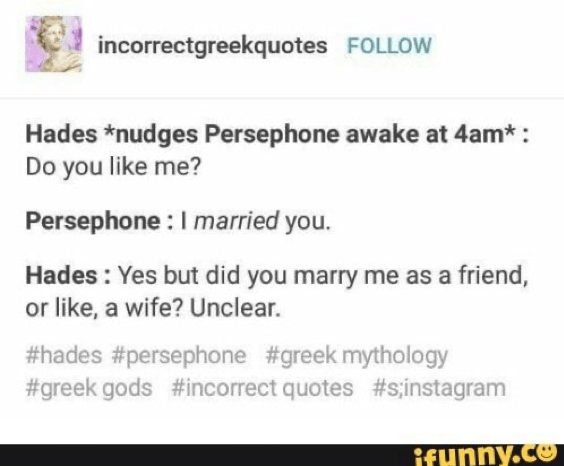
It isn’t unclear, sadly. Without consent, Persephone didn’t marry Hades even as a friend. She married him as a hostage. She remains his wife because she has no choice, as within the culture of Olympos, Persephone cannot go against the wishes of her supernatural, all-powerful father.
But you know what? I don’t mind that the young people are making Persephone and Hades a wholesome couple. I wish they would acknowledge that it’s what they are doing, though. It doesn’t need a historical precedent. It’s enough that they have looked at a myth of forced marriage and pain and have responded vehemently no. But I hope that they don’t lose sight of the forced marriage in the history of the tale, because it might help them recognise the real forms of forced marriage that are happening even now. And I wish they would take pride in the fact that they are choosing a better way to tell the story. Especially because the ways in which they’re doing so demonstrate that the new myth-makers have a sophisticated understanding of consent (‘Persephone ate the pomegranate willingly’ my friend in the comment section stated). It shows that they have nuanced and positive ideas of what a healthy relationship looks like: if a couple gets married, monogamy is probably an agreed upon term (Persephone and Hades feel bad for Hera, who is routinely ‘cheated on’ by Zeus). Love and comfort are key to a fulfilling relationship (Hades asks Persephone for emotional reassurance in the meme just above. Admittedly, doing so at 4am is a bit much, but whatever). Gestures of appreciation and care are important:

Hades picks flowers for Persephone, because she is the goddess of spring and will appreciate them. Even though flowers are probably completely outside of Hades’ interests, he has paid enough attention to his wife to know what she will like.

Persephone shows kindness and consideration for the wellbeing of Hades when she wonders if their surroundings could be improved to make him more comfortable, and happier (doing so at 3am is a bit much, but whatever).
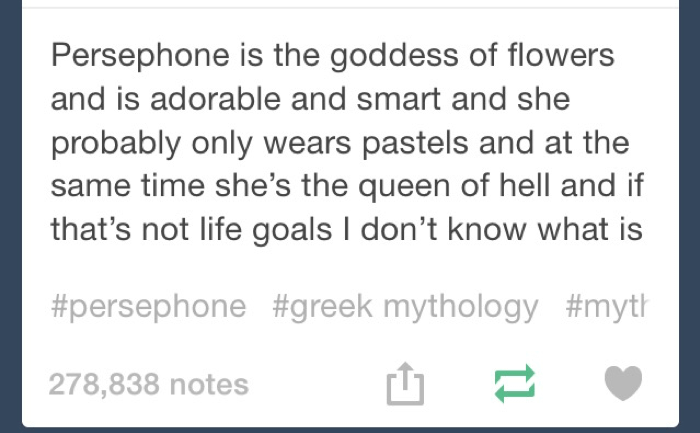
All that to say, that there isn’t an historical precedent for the marriage of Persephone to Hades being anything but forced. However, myths are not static creatures. I took some modules in the Classics during my undergrad, and as my tutor loved to emphasise: myths evolve with the telling. They get absorbed by other cultures, they get edited and amended. Gods become saints, heroes become stories, and here? A forced marriage is changing beneath the typing fingers of young people into something nurturing and beautiful and, most importantly, consensual. So go forth, new myth-makers of memes. Change the narrative. Rewrite the story and end forced marriage. Make it beautiful.
Written by Alex Carabine.
(P.S. Happy Winter solstice to Persephone – you’re halfway through the dark! … A)
 Drawing on Forced Marriage
Leave a comment