Of course, we aren’t the only folks talking about forced marriage. It’s such a pervasive issue that it’s being addressed around the world. Though this is troubling in terms of how widespread the problem is, it is also reassuring to know that there are a multitude of diverse people tackling it in different ways.
For example, The Conversation published this piece specifically about human trafficking in Australia (and how forced marriage can fall under the trafficking umbrella). And wouldn’t you know it – they use a comic, too! So not only did we want to bring your attention to this wonderful resource, but we also wanted to give you another example of how you can ‘close read’ the imagery of a comic, and how this skill can be utilised in the classroom.
There are some crucial forced marriage facts interspersed throughout the comic: for a start, Jane is 17. In Australia (like the UK) the legal age of marriage is 18, which means that what happens to Jane is a child marriage, which is definitely illegal. Secondly, her personal feelings are not taken into account. She does, after all, already have a boyfriend. A marriage can be many things, but one hopes that a marriage contains friendship, affection and care (which we can assume Jane already experiences with her chosen partner). Jane is also the victim of coercion and violence: her parents threaten her boyfriend, and she suffers verbal and physical assault from her parents. These are all common elements in the experience of forced marriage.
But I would like to draw your attention to the careful, non-triggering representation of violence in the comic, as seen in this excerpt:
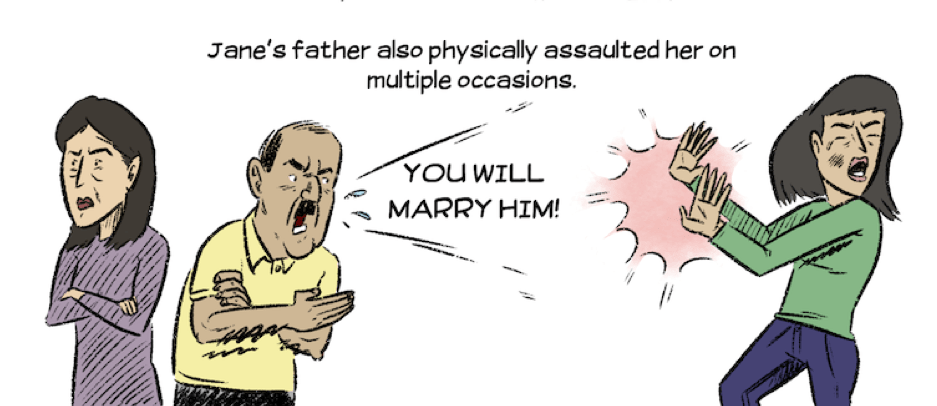
Comics are naturally a visual medium. They can choose to depict events either literally or symbolically. Because of this, artists are given an opportunity to be incredibly deliberate in their depictions of troubling subjects. It would be upsetting for readers to see Jane hurt by people who are supposed to love and care for her. Nevertheless, to omit the fact that she experiences assault would negate the lived experience of many victim-survivors. What to do? How do you approach this in a visual medium? I actually love what the artist has achieved. Jane is separated from her parents in the panel; her mother has her back turned and her arms crossed, indicating that she is angry with her daughter and refusing to engage with the situation unfolding between her husband and Jane. Jane’s father is facing towards her: his hand gestures out from his body, and spit flies from his mouth as he yells at his daughter. Without the text, this panel could simply represent an argument. But Jane has her hands up, as if to ward off a blow, and a spiky pink bubble of emanata frames her gesture, not unlike the KAPOW bubbles we may have seen in fight scenes in classic comic books. This, then, is a depiction of a verbal assault – yet it lands on Jane like a physical blow. Even her cheek is marked as if with a bruise. Add the imagery together with the text (‘Jane’s father also physically assaulted her’) and we realise that the artist has made a clever, sophisticated choice: yes, the violence must be expressed, but it does not need to be literally depicted. We know from the text and from the imagery what Jane has endured, and the artist has found a way to represent violence that doesn’t unduly distress the viewer. But, more importantly, it doesn’t remove the power from the image or the truth from events, either.
While married, Jane is forced to help her husband in his visa application, which shows how labour (physical, mental or emotional) are often part of the victim-survivor’s experience of forced marriage.
Luckily for Jane, she is able to go to court, where the marriage is declared invalid:

In the second panel of the excerpt above, the Judge’s seat acts as a barrier between Jane and her parents: the law is literally drawn in lines of defence against forced marriage. The judge is illustrated as slightly larger than the other characters, and she frowns down on the parents, dominating their figures. Jane smiles, tearful but relieved. Her arms are crossed now, symbolising her own emotional defences against her parents.
But the final image is a melancholy one. Jane is in her wedding dress, crying. There is colour behind her like light or a sunrise, indicating that this is a moment of hope (even as we’re remembering a tragic event in her past). Her feet are exposed beneath the hemline of her wedding dress, which I can’t help but read as increased mobility: if your skirts drag on the ground, how can you flee? Here, at least, Jane’s feet are free to carry her away from her awful marriage. Yet, she weeps. Just because she can leave the marriage doesn’t mean she will necessarily leave its emotional effects behind. She will have to live with the fact that her parents treated her like their property for the rest of her life.
Which leads me to wonder – what will happen to Jane, outside the confines of the comic? There is no guarantee her boyfriend will stay. If he’s around Jane’s age, then he is only young, too, and it is terrifying at any age to be threatened by another person. Perhaps he, also, will carry scars from Jane’s forced marriage, and their relationship won’t be able to grow, develop and maybe even end on its own terms. Jane’s parents took that from her. She can’t trust her family any more, but as a minor, where else can she go? Will she be taken into care? Could she continue her education and move into student rooms, or will her mental health be so adversely affected that she can’t face university? And what of her other future dreams, for her career or her relationships or her general hope for future adventures?
This forced marriage will be engraved on Jane’s life forever, and her emotional timeline will always be divided into ‘before’ and ‘after’ her parents forced her to marry against her will, regardless of whether or not it was legally binding. But thank goodness the law was on her side.
With support and care, Jane – and people like her – can heal and continue to have full and vibrant lives. But wouldn’t it be better if they were never compelled to carry these scars in the first place? That’s why raising awareness about forced marriage is so vital, especially amongst young people. We hope our comic will help someone like Jane before they are forced into marriage, and that their life will continue along a path of their choosing, rather than along a route that someone else has chosen for them.
One simple action you can take right now to help someone like Jane is to share our comic. You could tweet about it, reblog this post, or tell a school about us. One small, positive action can have hugely positive results!
Written by Alex Carabine
 Drawing on Forced Marriage
Leave a comment