As a literature scholar, one of the things I find most fascinating about forced marriage is the way in which it has been used as a source of entertainment in popular culture. To be clear, I’m not saying that forced marriage is entertaining. It’s a horrendous, egregious crime. And yet, it has regularly been used as inspiration in the arts (for example, The Odyssey by Homer represents the attempts of suitors to pressure Penelope into marrying one of them against her will. Modern readers might argue about the entertainment factor of classical literature, but I think we can agree that it counts as art). Something in the very human pain of forced marriage evokes a strong emotional response in the audience. Outrage. Compassion. Enough indignation to take action, hopefully.
And so, what I find interesting is the consistency of the topic. For example, I stumbled upon this broadsheet from the seventeenth century:
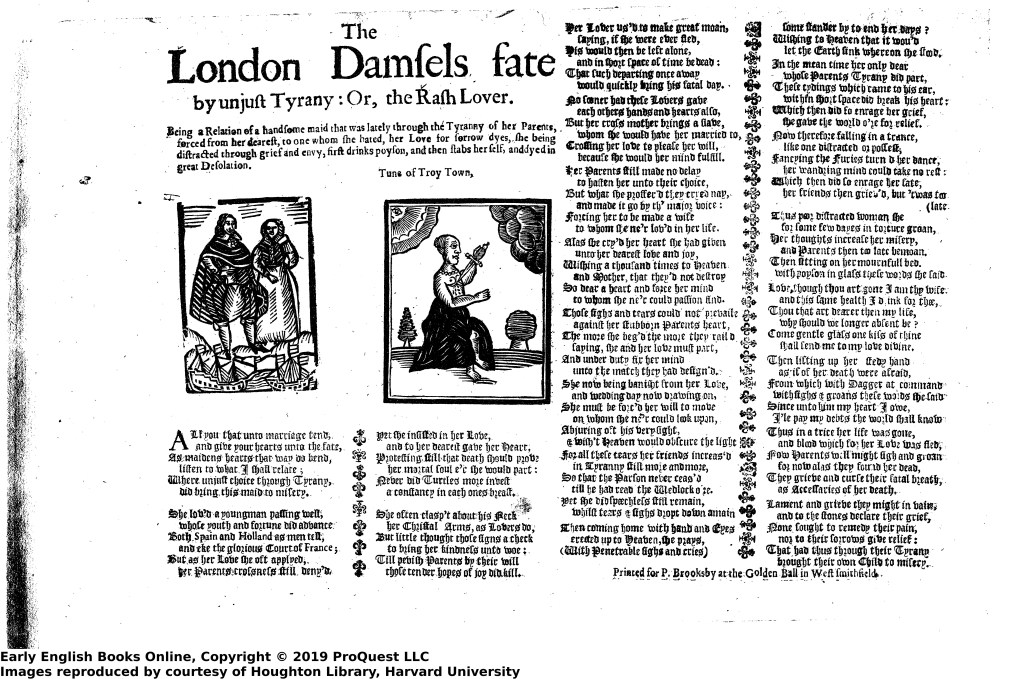
“Being a Relation of a handsome maid that was lately through the Tyranny of her Parents, forced from dearest, to one whom she hated, her Love for sorrow dyes, she being distracted through grief and envy, first drinks poyson, and then stabs herself, and dyed in great Desolation.”
This is technically a song, and if you fancy trying it out, you can sing it to the tune of Troy Town. If you want to read the whole thing, it’s available on ProQuest here. Unfortunately, you may need a university account to access it, but I want to share the most interesting points with you and so I have picked out a few excerpts.
The first verse acts as a warning, spoken by some form of narrator or moral voice. It sets the tone for the ballad immediately and acts as guide to those who are interested in marriage. It also acts as critic of those who bring young people to misery through acts of ‘tyranny’:
‘All you that unto marriage tend,
and give your hearts unto the fate,
As maidens’ hearts that way do bend,
listen to what I shall relate;
Where unjust choice through Tyranny,
did bring this maid to misery.’
The use of the word ‘tyranny’ implies that it is a cruel thing to force someone into marriage against their will. This leads me to a host of questions. For example, arranged marriages (and, one can imagine, forced and ‘gently forced’ marriages also occurred) were common amongst the upper classes during this era. And yet the upper classes weren’t necessarily the target audience for this song, as ballad broadsheets like this one tended to be aimed at the lower classes. So, does it act like a fairy tale? Are people critiquing upwards, socially speaking? Is it just a good story and I’m getting too hung up on details? All are possible.
Anyway, the parents dislike the lover the girl has chosen, and so:
‘Her Parents still made no delay
to hasten her unto their choice,
But what she proffer’d they cryed nay,
and made it go by th’ major voice:
Forcing her to be made a wife
to whom she ne’r lov’d in her life.’
Her parents disregard her wishes, and the girl is forced to marry someone she has never loved. This is common in forced marriages even today, where the emotional wellbeing, autonomy and choice of the victim-survivor are less important than the parents’ decision and authority.
No matter how hard the girl cries, her parents only increase their ‘tyranny’:
‘For all these tears her friends increas’d
in Tyranny still more and more,
So that the Parson never ceas’d
till he had read the Wedlock o’re.
Yet she did speechless still remain,
whilst tears & sighs dropt down amain.’
Of course, I can’t speak to how it was done in the eighteenth century, but in our modern era this wouldn’t be a valid marriage. That’s because the bride didn’t give her consent during the ceremony. Remember: silence is not consent. The maiden’s lover dies of his broken heart, and the girl decides to join him by drinking poison and ending her life. Her parents, bereft, realise too late the pain they put their daughter through.
Interestingly, the ballad has no patience for their remorse:
‘Lament and grieve they might in vain,
and to the stones declare their grief,
None sought to remedy their pain,
nor to their sorrows give relief:
That had thus through their Tyranny
brought their own Child to misery.’
If we can say that this ballad has a moral, it’s that parents shouldn’t force their child into a marriage against their will. I agree wholeheartedly, but it’s interesting how the ‘romance’ of an invented forced marriage can be turned into entertainment. Like Romeo and Juliet, I imagine the intention is to elicit an empathetic response in the audience. How terrible that the girl lost her true love, was betrayed by her own parents, and died by her own hand. Audiences are supposed to relish the tragedy of it. And yes, it is terrible. But amazingly, the ballad doesn’t stop with the romantic misfortune. It explicitly informs listeners that they cannot expect compassion if they behave like the parents in the ballad. That to force their child into an unwanted marriage is an act of tyranny, that no one will sympathise with them if they do so and thereby break their own hearts in the process.
I feel like I’m connecting with the writer of the ballad over a chasm of hundreds of years. Because here I am, writing to you, dear reader. I’m creating blogs using pop culture references, I’m referring to the law, I’m offering advice on where to find help. And like the ballad’s narrator, I’m telling anyone who will listen that forced marriage is wrong.
And of course, Hannah is part of this, too. Because she has created a comic to help address the issue of forced marriage. She has developed narratives that will educate school aged teenagers and equip them with the skills they need to protect themselves (and their loved ones) from forced marriage. And she’s done so in a way that students will find engaging and inspiring.
So here we are, three creators, united over hundreds of years. Each finding different ways to get the issue of forced marriage in front of as many people as possible, because we know that it is wrong and because we agree that it ought to be stopped. So, whether you sing it, read it, or carry the comic into a classroom, join in! Forced marriage is a terrible crime, and together we can help end the practice.
Written by Alex Carabine
 Drawing on Forced Marriage
Leave a comment