The World Museum in Liverpool is currently hosting the exhibition Return of the Gods. It shows a collection of over 100 statues that have never been seen together before. It’s a great exhibition, and I recommend you go (if you can – it closes in February). But why am I talking about it here?
Well, the curators decided to draw inspiration from comic books in the way that they displayed the pieces. This is taken from their statement online:
From Wonder Woman to Hercules our screens are dominated by chiselled superheroes wielding their power – but who inspired these indestructible figures? This family-friendly exhibition dives into ancient Greek and Roman mythology to expose the original ancient characters of the heroes and heroines of our time.
This is a great concept, though I think I would have appreciated it more if they’d deliberately pulled out actual connections between classical figures and modern heroes (Wonder Woman is an Amazon, after all). But I acknowledge that the comic companies may have been a significant barrier to that sort of comparison, and I can appreciate that they found a fun, compelling way to introduce young people to ancient myths.
So how do they invoke comic books in their display? Largely through their use of backdrops, which often depicted radiating halos of lines, not unlike those we might see in the classic KAPOW! comic frames.
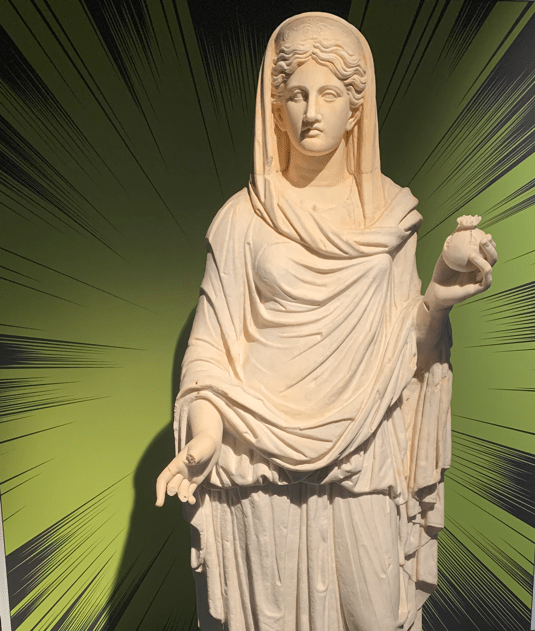
They also used the font we associate with classic comic books for the excerpts of ancient texts they displayed (in translation) on the walls. For example, this one, which tells part of the Persephone narrative:
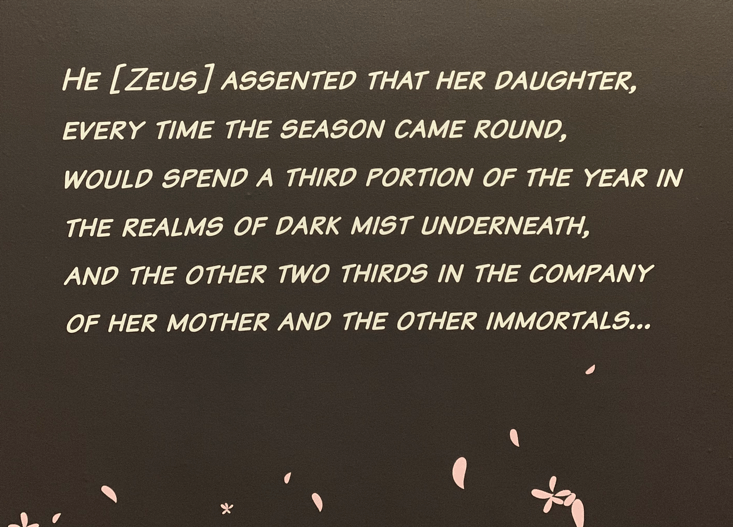
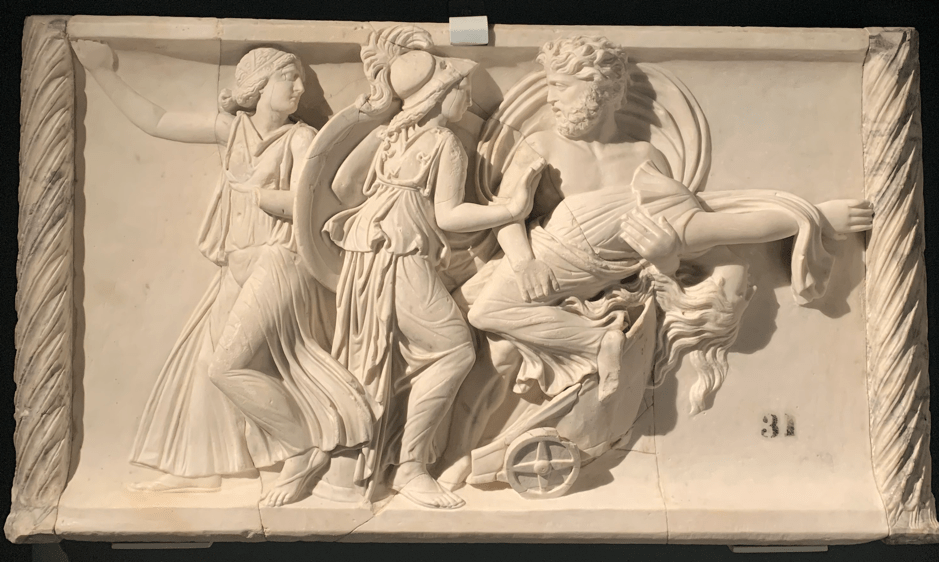
And this is where the exhibition and I begin to part ways. Because there’s a crucial phrase in their statement, quoted above: ‘family-friendly’. From this we know that the museum is trying to attract young people to the exhibition, and parents who might be familiar with the mythic narratives are immediately reassured that the exhibition will be suitable for children. Which is a fair enough concern. However… I don’t know. I find myself in a grey area. Because some descriptions of the art would, for example, define Zeus’ multitude of sexual assaults against women as ‘love affairs’.
Um…
I know. I know. Protecting children from such horrors is vitally important. But I can’t help but wonder – isn’t there a way we can talk meaningfully and sensitively to young people about these tough topics? Because by extension, that means we can alert them to the reality of practices like forced marriage. Ignorance doesn’t guarantee protection; it guarantees vulnerability.
But I do understand the bind the museum was in, and I’m sure they would have hated to upset children and their parents by sparking difficult conversations the parents didn’t consent to have with their children at that moment. Fair enough. And, absolutely, children should be protected. But part of that protection must be education, mustn’t it?
I think that’s the genius of the I Choose: Let’s Talk About Forced Marriage comic. The stories, though fictional, are based on lived experience. And they very carefully depict narratives of forced marriage in such a way that young readers can lead the discussion. Will Emina be safe with an older husband, even though she’s blind? What does it mean that Becca becomes pregnant after her father has bartered her into marriage? Nothing shocking or disturbing is represented, the readers aren’t confronted with anything that might hurt them. But for the curious, for the ready, the questions are there. And the teaching pack helps the adults in the young reader’s life gently guide them to the answers.
The museum is introducing a new generation to the classical myths, and I appreciate that to no end. I love the myths, messy and problematic as they are (though, as I mentioned in this post, myths are always being rewritten). And by introducing the comic theme, the museum found a way to make something classic into something contemporaneous and engaging. That is not an easy balance to strike! I just wish there had been more nuance in the descriptions, to spark discussion, to enhance education.
Because it’s through education that crimes like forced marriage can be recognised and, one day, ended. It’s up to us to teach young people about tough topics, so they can learn how to defend themselves and protect their loved ones.
You know. Like heroes.
Written by Alex Carabine
 Drawing on Forced Marriage
Leave a comment