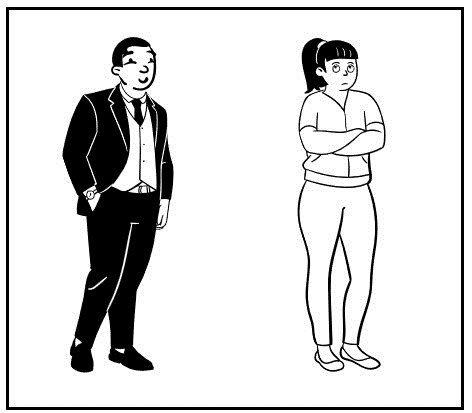
Forced marriage is a global problem that does not pass by the UK. The International Labour Organisation (ILO), Walk Free and the International Organisation for Migration (IOM) estimated that, worldwide, at least 22 million people lived in forced marriages in 2021. In 2022, around 300 people asked the UK’s Forced Marriage Unit (FMU) for advice about forced marriage.
But what is forced marriage?

According to the UK Government, “a forced marriage is where one or both people do not or cannot consent to the marriage and pressure or abuse is used to force them into the marriage. It is also when anything is done to make someone marry before they turn 18, even if there is no pressure or abuse. … The pressure put on people to marry against their will may be: physical: for example, threats, physical violence or sexual violence; emotional and psychological: for example, making someone feel like they are bringing ‘shame’ on their family. Financial abuse, for example taking someone’s wages, may also be a factor.”
This definition is in line with Section 121 of the Anti-Social Behaviour, Crime and Policing Act 2014 that makes forced marriage illegal in the UK. The section has recently been amended by the Marriage and Civil Partnership (Minimum Age) Act 2022. The Act increased the minimum age of marriage from 16 with parental consent to 18 and criminalised child marriage in the UK.
While criminal law punishes perpetrators – well, four perpetrators have been convicted of forced marriage in the UK so far – civil law aims to protect those at risk of or already in a forced marriage. According to section 63B(1) of the Forced Marriage (Civil Protection) Act 2007, Forced Marriage Protection Orders (FMPO) forbid a person (A) from doing anything to force another (B) to marry. For example, a FMPO can forbid A to contact B, or to take B abroad. Section 120 of the Anti-Social Behaviour, Crime and Policing Act 2014 makes it a crime to breach a FMPO. Compared to the low number of successful forced marriage prosecutions, many more FMPOs are approved every year, approximately 200 – 250. However, there are “regular breaches”, for example when A uses another passport or dual passport to take B abroad.
In addition to civil law, the Human Rights Act 1998 protects Bs at risk of or already experiencing forced marriage. Forced marriage is a violation of the right to marry. It can also be a form of modern slavery when control tantamount to possession is exercised over Bs. While forced marriage does not automatically and necessarily lead to unhealthy or abusive relationships, it can include inhuman or degrading treatment in the form of serious physical assault and/ or treatment that is extremely humiliating and undignified.
Forced marriage can also have a negative impact on B’s physical and mental health and well-being, on their education and career, and on their social life.
If forced marriage is so harmful, why does it happen then?
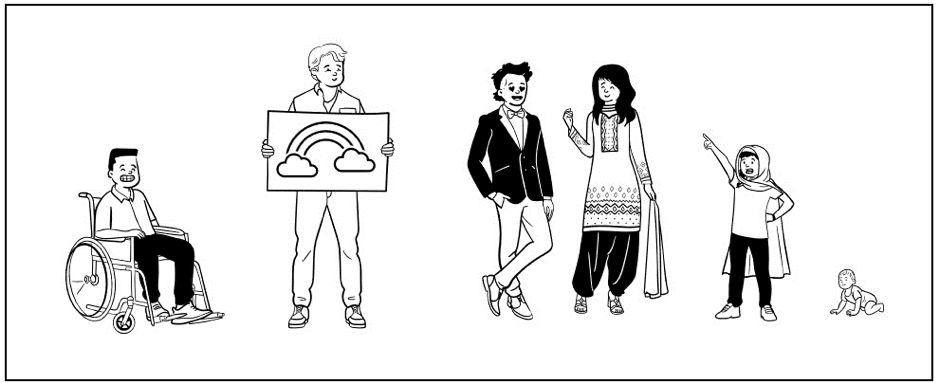
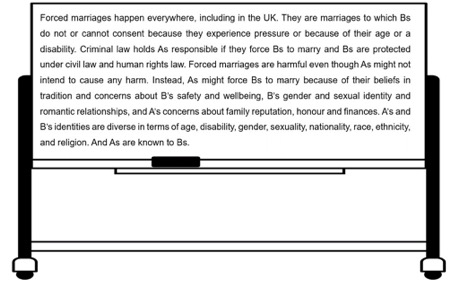
Forced marriages can happen for many reasons and harm can be unintended. For example, A could force B to marry because A is worried about the family’s reputation and honour. A might try to justify forced marriage as part of their traditions and beliefs and think that it is their obligation to comply. A might also see forced marriage as a way to pay off a family debt or to ensure what they consider to be a better future for B. Or A might not want B to have romantic relationships they do not approve of and/ or sex outside marriage and force them into a marriage to prevent that. Or A might see forced marriage as a way to hide or cure B’s LGBTQIA+ identity.
And who are A and B?
Well, it would probably be better to speak of As plural rather than A singular because it is common for there to be multiple perpetrators involved in a forced marriage. For example, As can be male and female family members, friends, and members of the community. Usually, they are older than Bs.
While statistics show that most Bs are female, they can be male as well. Around 30 – 40 % of Bs are children.
And as the ILO, Walk Free and IoM show, As and Bs are everywhere. Forced marriages happen in many nationalities, ethnicities, cultures and religions. In 2021, the FMU’s focus countries with the highest number of cases were Pakistan, Bangladesh, Somalia, Kenya, Iraq, and Romania. Savera UK’s data shows that most As and Bs are Muslim followed by Christian, Hindu, Atheist, and Bahai. It is important to remember thought that not every member of those communities experiences forced marriage and all major religions are against the practice.
So what have we learned?
And now?
Knowledge is power. Be studious. Increase and spread it.
Why?
So that we can end forced marriage.
Why?
…
Written by Hannah Baumeister
 Drawing on Forced Marriage
Leave a reply to A Statutory Definition of “Honour”-Based Abuse – Drawing on Forced Marriage Cancel reply